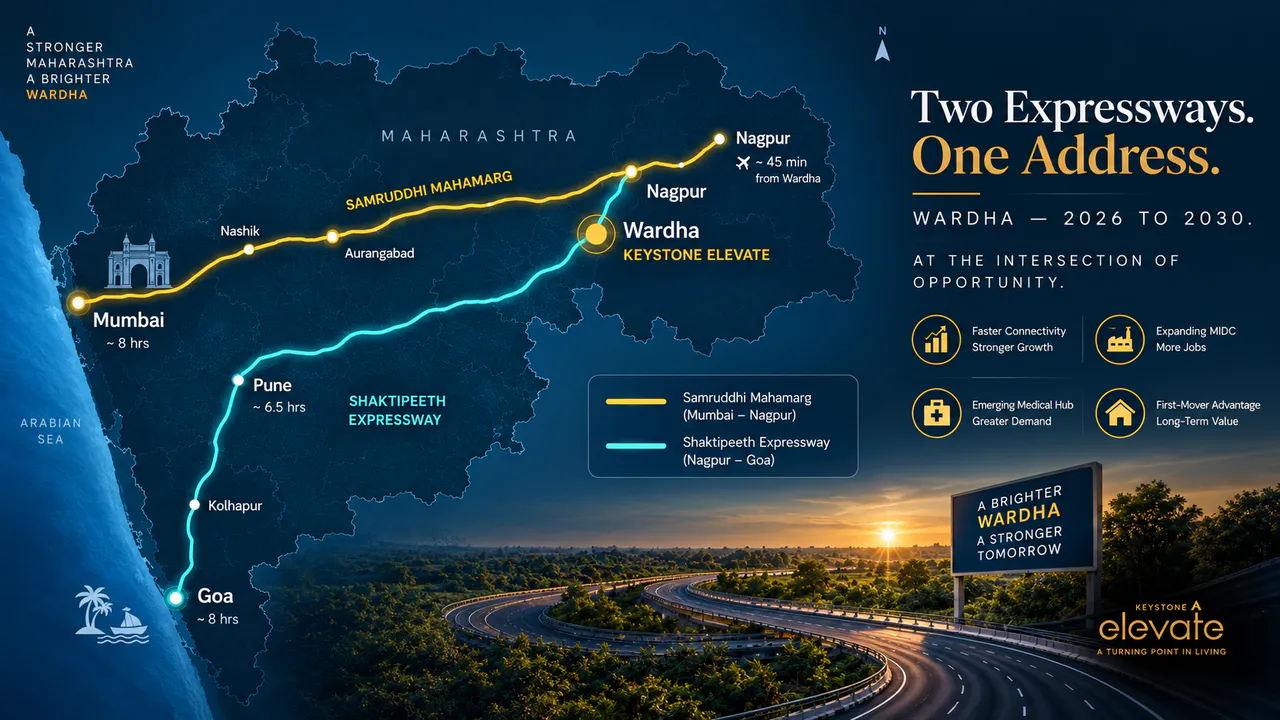
Every city that becomes a significant residential address does so for one of three reasons: it is a financial hub (Mumbai), it is an IT hub (Bengaluru), or it sits at the intersection of major infrastructure (Surat, Navi Mumbai, Pune). Wardha is developing a version of the third — it is being placed, by government decision and infrastructure investment, at the intersection of two of Maharashtra’s major expressways, in a medical and industrial belt that is actively growing.
This document makes an investment case. It is not a guarantee of returns — real estate investment always carries risk, and anyone who guarantees returns is either uninformed or dishonest. What it presents is a logical analysis of the factors that typically drive real estate appreciation in Tier 2 Indian cities, applied specifically to Wardha. The evidence, fairly evaluated, suggests that 2026 is an unusually good entry point.
The Mumbai–Nagpur Samruddhi Mahamarg became fully operational in June 2025. At 701 km, it is India’s longest expressway and reduces Wardha-to-Nagpur travel time from approximately 90 minutes to under 45 minutes.
The impact of this single infrastructure development on Wardha’s real estate has two components. The first is the commuter-resident effect: professionals who work in Nagpur’s hospitals, courts, colleges, and corporate offices can now genuinely consider living in Wardha. This creates a demand category that did not exist before June 2025. The second is the psychological effect: Wardha is no longer perceived as ‘far from Nagpur’. The mental map of residents and investors has shifted. When something is 45 minutes from a large city, it is an extended suburb — not a remote outpost.
In comparable situations — highway connectivity reducing travel time to a major city by 30–50% — Indian real estate markets have historically seen price appreciation of 30–60% within 5 years of the highway becoming operational, concentrated most strongly in the first-mover luxury segment where supply is most constrained. The NH-7 bypass impact on Wardha in the early 2000s offers a local analogue. The Samruddhi effect is expected to be significantly larger.
The Shaktipeeth Expressway — a proposed 856 km route from Nagpur to Goa — is anchored at Pavnar in Wardha district. When this expressway is complete (planning and early execution stages as of 2026), Wardha will sit at the intersection of two major Maharashtra expressways: the Samruddhi (east-west, Mumbai to Nagpur) and the Shaktipeeth (north-south, Nagpur to Goa).
The pattern of real estate appreciation at expressway intersections is well-documented in India: Surat at the intersection of the Delhi-Mumbai Industrial Corridor and the national highway network saw land values triple in the decade following connectivity. Pune’s strategic position at multiple national highways created the city’s expansion into Hinjewadi and Kharadi. Wardha at the Samruddhi + Shaktipeeth intersection is, in structural terms, comparable — at an earlier stage of the appreciation curve.
Buyers who purchase at Keystone Elevate in 2026 are entering before the Shaktipeeth effect is priced in. This is the classic first-mover position in infrastructure-adjacent real estate.
The Maharashtra Industrial Development Corporation has established six industrial zones in Wardha district covering 513 hectares, with 848 industrial plots of which 346 are operational and 165 under construction. The industrial sectors represented include textiles and cotton processing, food processing, engineering, and light manufacturing.
Industrial expansion brings with it a professional and managerial workforce that has no premium residential option in Wardha today. Plant managers, division heads, and senior executives at MIDC-based companies typically earn ₹12–30 lakh per year — placing them squarely in Keystone Elevate’s target buyer profile — but have had no option other than rented accommodation or basic mid-range apartments. As MIDC expands and the managerial workforce grows, demand for premium residential options will increase. Keystone Elevate, as the only product in this category, captures this demand entirely.
Wardha district hosts two major medical educational institutions: Mahatma Gandhi Institute of Medical Sciences (MGIMS) at Sewagram — one of India’s oldest and most respected rural medical institutions — and Datta Meghe Institute of Medical Sciences at Sawangi. Combined, these institutions attract hundreds of senior medical faculty, specialist doctors, hospital administrators, and researchers to Wardha as a permanent or semi-permanent base.
Medical professionals are among the highest-income buyers in any Tier 2 market and are disproportionately represented in luxury real estate purchases. In comparable Tier 2 markets (Raipur, Vadodara, Coimbatore), the expansion of private medical institutions has directly driven premium residential demand. The medical hub effect in Wardha is structural — it grows as the institutions grow, and both MGIMS and Datta Meghe are expanding.
When a Tier 2 Indian city receives its first integrated gated luxury community, it creates a new price benchmark that subsequent projects are measured against. The first-mover project becomes the reference standard. Early buyers in this project typically see above-average appreciation because: the product is unique (no direct competition initially), the location chosen by the developer is typically prime (the developer was first to access the best land), and the community effect creates a social premium (everyone knows who lives in the first luxury community).
The evidence from comparable cities: Early gated society apartments in Nagpur’s Dharampeth (2005–2010 launches) appreciated at 2–3× the rate of standalone bungalows in the same area over the following decade. Indore’s first integrated townships on the AB Road corridor (2008–2014) generated 3–4× appreciation vs peripheral plots in the same period. Aurangabad’s first premium gated societies created similar first-mover premiums. Wardha is at the same inflection point that Nagpur was in 2008.
Buying at Keystone Elevate in 2026 means:
(1) entering a market with one product in the luxury category and no direct competition;
(2) entering before the Shaktipeeth Expressway is priced in;
(3) entering as the addressable professional population grows through MIDC and medical institution expansion;
(4) entering at a time when India’s luxury residential segment is growing at 14% year-on-year with homes above ₹1 crore accounting for 50% of all sales;
(5) entering as the Samruddhi commuter-resident effect is still in its early phases.
No investment comes without risk. The specific risks for this investment include:
(a) economic slowdown reducing discretionary real estate demand;
(b) policy changes affecting the real estate sector;
(c) cotton harvest failures reducing agri-business buyer liquidity in specific years;
(d) execution risk on any under-construction project. These risks are mitigated by MahaRERA legal protection, the developer’s documented delivery track record, the 1% booking structure (minimising capital at risk during construction), and the fundamental demand growth factors outlined above.
The question for the investor in 2026 is not ‘will Wardha appreciate?’ — the infrastructure convergence almost guarantees some appreciation. The question is ‘what is the right vehicle for capturing that appreciation?’ Keystone Elevate is the only organised, RERA-registered, high-quality residential product in Wardha’s luxury segment. It is, structurally, the best vehicle available.
 Explore More
Amenities Are Not a List. They Are a Way of Life. The real test of an amenity list...
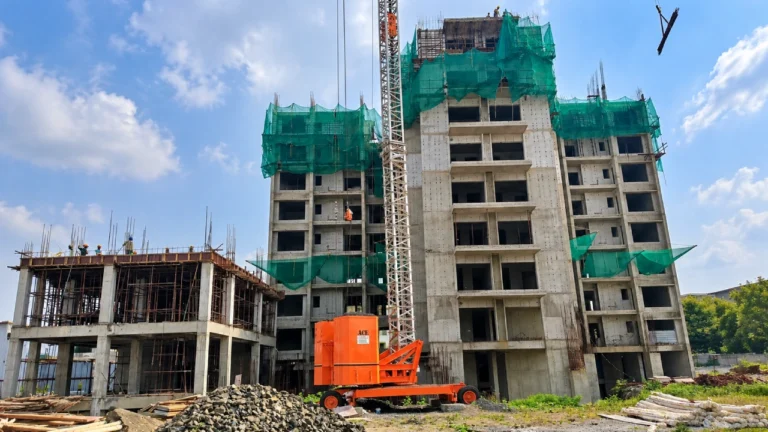
Why Monthly Updates Matter A construction update is not marketing. It is accountability. Every update from Keystone Elevate...
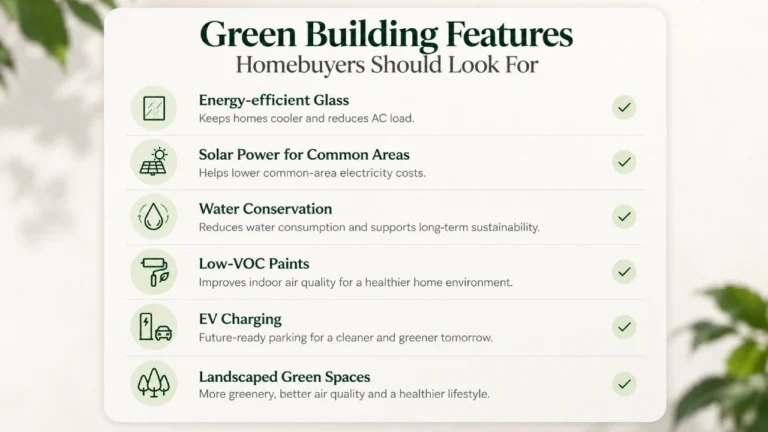
Beyond the Label — What Green Building Actually Delivers Green ratings in India range from meaningful to cosmetic....